

Psychosocial Risks:
do you know what you’re looking for?
You have probably read or heard many of these words:
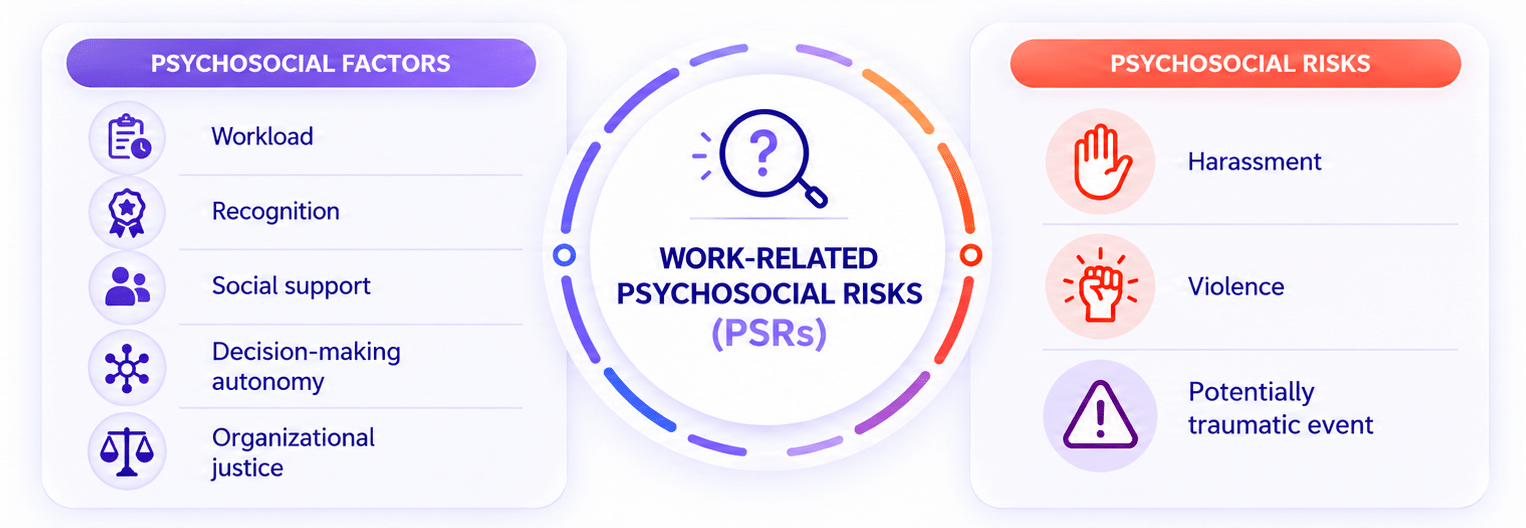
All of these terms come up when we talk about work-related psychosocial risks (PSRs). Each refers to a distinct reality, and the distinction is far from theoretical. It changes what an organization observes, what it seeks to prevent and, ultimately, the measures it puts in place.

Work is never neutral
Psychosocial factors are present long before a problem arises. They are found in how work is distributed, in decisions, available resources, relationships, the degree of latitude people are given, and the way efforts are recognized. They are part of the work itself.
The CNESST recognizes five factors:
- Workload
- Recognition
- Support at work
- Decision-making autonomy
- Organizational justice
Each of these factors can act as a risk factor or a protective factor, depending on the conditions in which it operates.
Here is how two of them can play this dual role.
Take workload. Work can be demanding while remaining sustainable when the resources are there to meet the demands, priorities are clear and support is accessible. The work remains demanding, but it remains manageable. When demands consistently exceed available resources, emergencies pile up, priorities conflict and support is lacking, the picture changes.
Decision-making autonomy offers another good example. It allows people to exercise their judgment and draw on their skills, and it is fully expressed within a clear framework, with the necessary resources and support. When these reference points disappear, what was meant to provide latitude can instead become a source of pressure.
Psychosocial factors are distinguished by how they manifest in real work, an area where the organization can act.
Risk rarely develops around a single factor
Imagine that a position remains vacant.
The workload increases.
The manager, already overwhelmed, becomes less available.
Priorities change frequently.
Some decisions are not explained as clearly.
Irritants build up within the team.
Taken individually, each of these elements tells a fragment of the story. Together, they reveal a work configuration that can become a source of risk. It is therefore not the factor itself that determines the risk. It is how it fits within the broader working conditions. This organizational dynamic most often consists of several factors that accumulate and interact. A single factor, when sufficiently severe or prolonged, can also be enough.
A common pitfall is turning the identification of PSRs into an inventory.
Check off “workload.”
Check off “support at work.”
Check off “recognition.”
Then consider the exercise complete.
Identifying the risk factors present in a workplace is a starting point. The next step is to observe how they combine in the work of teams and act on the conditions so that these same factors protect rather than weaken.
Risks that have a name
Harassment, violence and exposure to a potentially traumatic event refer to concrete situations that can affect health, safety and physical and psychological integrity. These are the PSRs that the CNESST prioritizes among the predominant work-related risks in Quebec.
Here again, prevention means looking before the situation is fully established.
Harassment, for example, can be preceded by warning signs: repeated incivility, persistent tensions, behaviors that become normalized, a growing sense of discomfort. These signs give reason to look at what may be developing, well before it is possible to conclude that harassment has occurred.
In the case of violence, some events arise without warning. Others occur in contexts where exposure or certain signs were already known. Prevention then means recognizing these contexts and preparing to act before the situation escalates.
The same logic applies to exposure to a potentially traumatic event.
Some events remain unpredictable. When the risk is known, however, it becomes possible to reduce exposure, prepare intervention mechanisms, clarify roles and strengthen protective factors.
Prevention is as much about recognizing what can be anticipated as it is about preparing for it, knowing how to intervene when the situation requires it, and supporting the people who experience its consequences.
Identifying PSRs therefore means going beyond what is already going wrong: it means understanding what, in the work itself, protects people, makes them more vulnerable, or exposes them. Once these risks have been identified, what does the Act to modernize the occupational health and safety regime (LMRSST), commonly referred to as Law 27, require in order to address them?
The second part of this series will answer this question and provide a better understanding of the next steps in the process.
Daisy Gauthier is an expert in workplace psychological health and occupational health and safety. A specialist in work-related psychosocial risks, her career has taken her from the field to consulting, contributing to the evolution of prevention practices in Quebec. Today, through Désia, she supports workplaces as a speaker, trainer, and strategic advisor.