

Psychosocial Risks: do you know what you’re looking for? — Part 1

Psychosocial Risks: do you know what you’re looking for? — Part 1

Psychosocial Risks:
do you know what you’re looking for?

You have probably read or heard many of these words:
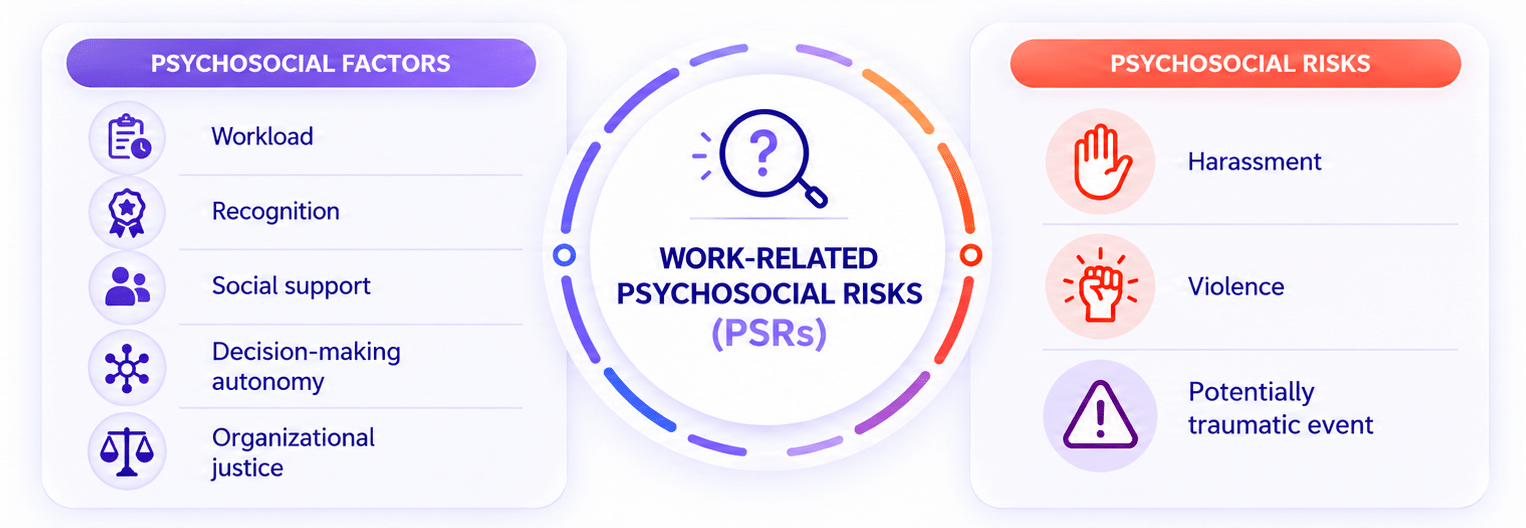
All of these terms come up when we talk about work-related psychosocial risks (PSRs). Each refers to a distinct reality, and the distinction is far from theoretical. It changes what an organization observes, what it seeks to prevent and, ultimately, the measures it puts in place.

 

Work is never neutral

Psychosocial factors are present long before a problem arises. They are found in how work is distributed, in decisions, available resources, relationships, the degree of latitude people are given, and the way efforts are recognized. They are part of the work itself.

The CNESST recognizes five factors:

  • Workload
  • Recognition
  • Support at work
  • Decision-making autonomy
  • Organizational justice

Each of these factors can act as a risk factor or a protective factor, depending on the conditions in which it operates.

Here is how two of them can play this dual role.

Take workload. Work can be demanding while remaining sustainable when the resources are there to meet the demands, priorities are clear and support is accessible. The work remains demanding, but it remains manageable. When demands consistently exceed available resources, emergencies pile up, priorities conflict and support is lacking, the picture changes.

Decision-making autonomy offers another good example. It allows people to exercise their judgment and draw on their skills, and it is fully expressed within a clear framework, with the necessary resources and support. When these reference points disappear, what was meant to provide latitude can instead become a source of pressure.

Psychosocial factors are distinguished by how they manifest in real work, an area where the organization can act.

Risk rarely develops around a single factor

Imagine that a position remains vacant.

The workload increases.
The manager, already overwhelmed, becomes less available.
Priorities change frequently.
Some decisions are not explained as clearly.
Irritants build up within the team.

Taken individually, each of these elements tells a fragment of the story. Together, they reveal a work configuration that can become a source of risk. It is therefore not the factor itself that determines the risk. It is how it fits within the broader working conditions. This organizational dynamic most often consists of several factors that accumulate and interact. A single factor, when sufficiently severe or prolonged, can also be enough.

A common pitfall is turning the identification of PSRs into an inventory.

Check off “workload.”

Check off “support at work.”

Check off “recognition.”

Then consider the exercise complete.

Identifying the risk factors present in a workplace is a starting point. The next step is to observe how they combine in the work of teams and act on the conditions so that these same factors protect rather than weaken.

Risks that have a name

Harassment, violence and exposure to a potentially traumatic event refer to concrete situations that can affect health, safety and physical and psychological integrity. These are the PSRs that the CNESST prioritizes among the predominant work-related risks in Quebec.

Here again, prevention means looking before the situation is fully established.

Harassment, for example, can be preceded by warning signs: repeated incivility, persistent tensions, behaviors that become normalized, a growing sense of discomfort. These signs give reason to look at what may be developing, well before it is possible to conclude that harassment has occurred.

In the case of violence, some events arise without warning. Others occur in contexts where exposure or certain signs were already known. Prevention then means recognizing these contexts and preparing to act before the situation escalates.

The same logic applies to exposure to a potentially traumatic event.

Some events remain unpredictable. When the risk is known, however, it becomes possible to reduce exposure, prepare intervention mechanisms, clarify roles and strengthen protective factors.

Prevention is as much about recognizing what can be anticipated as it is about preparing for it, knowing how to intervene when the situation requires it, and supporting the people who experience its consequences.

Identifying PSRs therefore means going beyond what is already going wrong: it means understanding what, in the work itself, protects people, makes them more vulnerable, or exposes them. Once these risks have been identified, what does the Act to modernize the occupational health and safety regime (LMRSST), commonly referred to as Law 27, require in order to address them?

The second part of this series will answer this question and provide a better understanding of the next steps in the process.

Daisy Gauthier is an expert in workplace psychological health and occupational health and safety. A specialist in work-related psychosocial risks, her career has taken her from the field to consulting, contributing to the evolution of prevention practices in Quebec. Today, through Désia, she supports workplaces as a speaker, trainer, and strategic advisor.


inpowr Newsletter

Get the best of organizational health every month

Analysis, case studies and expert insights to help prevent psychosocial risks and build healthier, higher-performing organizations.

Free • Unsubscribe in one click

Recovery: the new challenge in PSR prevention

Recovery: the new challenge in PSR prevention

Recovery: the new challenge in PSR prevention

This content was written for Congrès RH 2026 in Québec City.

What if the next challenge in psychosocial risk prevention were recovery?

Discover why it is becoming a strategic lever for HR and how the Organizational Recovery Radar can guide concrete actions.

For a long time, psychosocial risk prevention focused primarily on well-known factors: high workload, lack of autonomy, conflict, low recognition, or harassment. These risks remain critical, but changes in the way we work now require organizations to monitor another issue: difficulty recovering.

Hybrid work, collaborative tools, artificial intelligence, notifications, and expectations of availability are transforming the way we work, but also our ability to disconnect. The workday may be over without the work truly being over: a message is checked, a meeting is anticipated, or a file continues to occupy our thoughts. Paradoxically, our devices recover better than we do.

Yet recovery is far from a luxury. It refers to the process through which the physical, cognitive, and emotional resources mobilized at work are gradually restored (Sonnentag & Fritz, 2007). When recovery is insufficient, fatigue accumulates, concentration decreases, and performance becomes more difficult to sustain over time (Sonnentag, 2018).

Recognizing the signs of insufficient recovery

For HR, the first challenge is recognizing the signs. They do not always take the form of absences or explicit complaints. They can also appear as:

  • Days filled with meetings and no time to focus;
  • Messages sent or handled in the evening;
  • Breaks that are regularly postponed;
  • Difficulty distinguishing urgent requests from those that are simply important;
  • People who continue working despite fatigue, distress, or a health problem.

This last behaviour may resemble presenteeism: people try to maintain their contribution despite diminished resources (Karanika-Murray & Biron, 2020). It does not depend solely on their individual ability to manage stress. It is also influenced by workload, autonomy, expectations, and the support available.

Moving from awareness to action

Encouraging people to sleep better, take breaks, or build their resilience can be useful. However, these measures will have little effect if organizational practices continue to limit opportunities for recovery.

Recent research on the organizational climate for recovery highlights, in particular, the importance of workload management, autonomy, manager support, and organizational practices that support recovery (Toscano et al., 2026).

In practical terms, HR can begin the discussion with an Organizational Recovery Radar built around five questions:

  1. Availability: Are expected response times clearly defined?
  2. Workload: Do teams have enough capacity to absorb unexpected demands?
  3. Management: Do managers protect breaks, vacation time, and periods of focused work?
  4. Technology: Do digital tools simplify work or multiply interruptions?
  5. Culture: Is the focus on results or constant availability?

The goal is not to transform everything at once, but to identify the main obstacles to recovery, choose one realistic action, and monitor its effects. This could mean, for example, reducing low-value meetings, protecting certain periods for focused work, clarifying levels of urgency, or using scheduled email delivery.

Preventing psychosocial risks therefore no longer means only reducing what causes exhaustion. It also means addressing the practices, norms, and tools that prevent people from truly recovering.

At Congrès RH 2026, I will present the Organizational Recovery Radar, a concrete tool for identifying risk areas, targeting priorities, and taking action. Because recovery is an essential condition for sustainable health and performance.

References

Karanika-Murray, M., & Biron, C. (2020). The health-performance framework of presenteeism: Towards understanding an adaptive behaviour. Human Relations, 73(2), 242–261.

Sonnentag, S. (2018). The recovery paradox: Portraying the complex interplay between job stressors, lack of recovery, and poor well-being. Research in Organizational Behavior, 38, 169–185.

Sonnentag, S., & Fritz, C. (2007). The Recovery Experience Questionnaire: Development and validation of a measure for assessing recuperation and unwinding from work. Journal of Occupational Health Psychology, 12(3), 204–221.

Toscano, F., Zappalà, S., & Donati, S. (2026). Recovery from Work in a Broader Perspective: Conceptualizing the Organizational Climate for Recovery. Australian Journal of Career Development, 35, 119–129.

To learn more about the conference that inspired this content.

Sandra Salvoni is Vice-President and Scientific Director – Organizational Health and Wellness at inpowr.

inpowr Newsletter

Get the best of organizational health every month

Analysis, case studies and expert insights to help prevent psychosocial risks and build healthier, higher-performing organizations.

Free • Unsubscribe in one click
Do your surveys give you a false sense of PSR prevention?

Do your surveys give you a false sense of PSR prevention?

Psychosocial risks (PSRs) are being measured more often today, but are far less often prevented at the source.

In many organizations, the reflex is now well established.

The climate is deteriorating.
Tensions rise.
Turnover becomes a concern.
Teams talk more about fatigue or overload.

So, a survey is sent out.

A few weeks later, the results come in, along with the charts. Generally, a certain sense of relief sets in; the organization finally feels that it understands what is happening.

The danger is that organizations sometimes confuse consultation with prevention. Gathering perceptions does not mean understanding what, in the work itself, gives rise to PSRs. 

In occupational health and safety (OHS), a much more uncomfortable question needs to be asked:

Does the survey actually make it possible to identify PSRs, or does it mainly measure consequences that are already established enough to become visible?

In prevention, there is a major difference between:

  • Observing effects such as an increase in distress in certain teams;
    and
  • Understanding the source of what produces them in the work.

This distinction completely changes an organization’s actual ability to prevent PSRs.

What a survey can do and its limits

Let’s be clear: a survey can be useful. It can:

  • Open discussions;
  • Make certain perceptions visible;
  • Document certain concerns;
  • Inform organizational reflection.

Many tools that have not been scientifically validated have significant methodological limitations when it comes to properly identifying PSRs and their psychosocial risk factors (PSRFs).

In many cases:

  • The dimensions assessed are not based on recognized OHS frameworks or on models validated for PSR prevention;
  • The PSRFs influencing PSRs remain poorly documented;
  • The tools do not always allow for a sufficiently reliable interpretation of the realities observed;
  • The results may be influenced by the context, emotions at the time, or certain recent events.

As with any measure based on human perceptions, some biases remain possible. Questionnaires based on validated models nevertheless seek to better control these effects in order to obtain data that are more stable, reliable, and representative of workplace realities.

When an organization wants to measure air quality, noise levels, or exposure to a contaminant, it does not rely on general impressions or improvised tools. It uses recognized methods, reliable tools, and interpretable data.

Since PSRs can also directly affect OHS, identifying them must meet the same level of methodological rigor.

When measuring does not mean preventing

The problem is not asking questions. The problem is believing that a general perception survey can, on its own, identify PSRs within an OHS prevention approach.

PSRs generally do not begin when they show up in a survey; they often take shape gradually:

  • Under certain repeated constraints;
  • In ways of working that become established;
  • In silent build-ups;
  • In overload that has become normal;
  • In a lack of support that persists;
  • In tensions that eventually become tolerated in day-to-day work.

These realities cannot be understood from a point-in-time snapshot.

Why this distinction is becoming essential

Even today, many workplaces reduce PSRs to a survey exercise. As if taking a snapshot of the discomfort was enough, on its own, to understand its causes in the work.

In OHS, simply identifying a risk has never been enough to address it.

With Law 27, organizations are expected to integrate PSRs into a genuine prevention process: identify, analyze, correct, control, and monitor the work-related factors that influence psychological health. These factors include work organization, management practices, employment conditions, as well as social relations at work.

It is not only about gathering perceptions, but about developing an organizational capacity to prevent harm to health, safety, and physical and psychological integrity. This is a genuine paradigm shift in OHS when it comes to PSRs because the gap between these two realities is much greater than it may appear.

Organizations must be able, in particular, to:

  • Identify the factors influencing PSRs;
  • Analyze their organizational realities;
  • Prioritize actions;
  • Implement appropriate prevention and control measures;
  • Monitor how risks evolve over time;
  • Evaluate and adjust their actions as workplace realities evolve.

This shift transforms the very understanding of PSR prevention in OHS:

  • From an approach focused mainly on visible consequences;
    To
  • An approach focused on understanding PSRFs, prevention at the source, and the continuous adjustment of working conditions.

What organizations now need to develop

Many organizations already have surveys, indicators, and internal data.

Organizations now need tools capable of producing reliable, comparable, and interpretable data over time in order to support a more accurate understanding of workplace realities.

Beyond the visible results, the challenge is also to better identify the factors influencing PSRs in order to guide prevention actions in a coherent, structured, and sustainable way.

Two Approaches That Do Not Pursue the Same Objective

Survey

Primarily measures perceptions
Point-in-time snapshot
Questions whose validity varies depending on the tools used
Results difficult to interpret
Primarily observes visible effects
May limit understanding of the factors influencing PSRs

Validated Questionnaire

Seeks to identify the factors influencing PSRs
Tracks change over time
Scientifically recognized dimensions
Reliable and comparable data
Supports risk identification and targeted prevention
Structured OHS prevention process


A survey can help inform organizational reflection and form part of a broader prevention process. However, on its own, it does not adequately identify PSRs within a structured OHS prevention approach.

Where the approach really changes how PSRs are understood

Some approaches specifically seek to move beyond the logic of a point-in-time survey by relying on scientifically validated questionnaires integrated into a structured PSR prevention process.

These approaches make it possible to:

  • Identify the factors that truly influence PSRs;
  • Monitor how workplace realities evolve over time;
  • Take a more strategic view of organizational trends;
  • Provide more consistent direction for prevention actions.

This methodology therefore makes it possible to obtain reliable, comparable, and interpretable data over time in order to support more consistent, strategic, and sustainable management of PSRs.

In OHS, the quality of data collection directly influences the quality of the decisions that follow.

The challenge is to stop waiting for the consequences to become observable before taking action on the workplace realities that produce them.

Prevention is most meaningful when it makes it possible to intervene early, collectively, and concretely in order to act sustainably on the factors influencing PSRs.

An important question for organizations

Does your organization rely on a perception survey or on a structured process using scientifically validated questionnaires to identify, analyze, and prevent PSRs?

Content written by Daisy Gauthier, expert and workplace partner in OHS and PSR prevention.

inpowr Newsletter

Get the best of organizational health every month

Analysis, case studies and expert insights to help prevent psychosocial risks and build healthier, higher-performing organizations.

Free • Unsubscribe in one click